
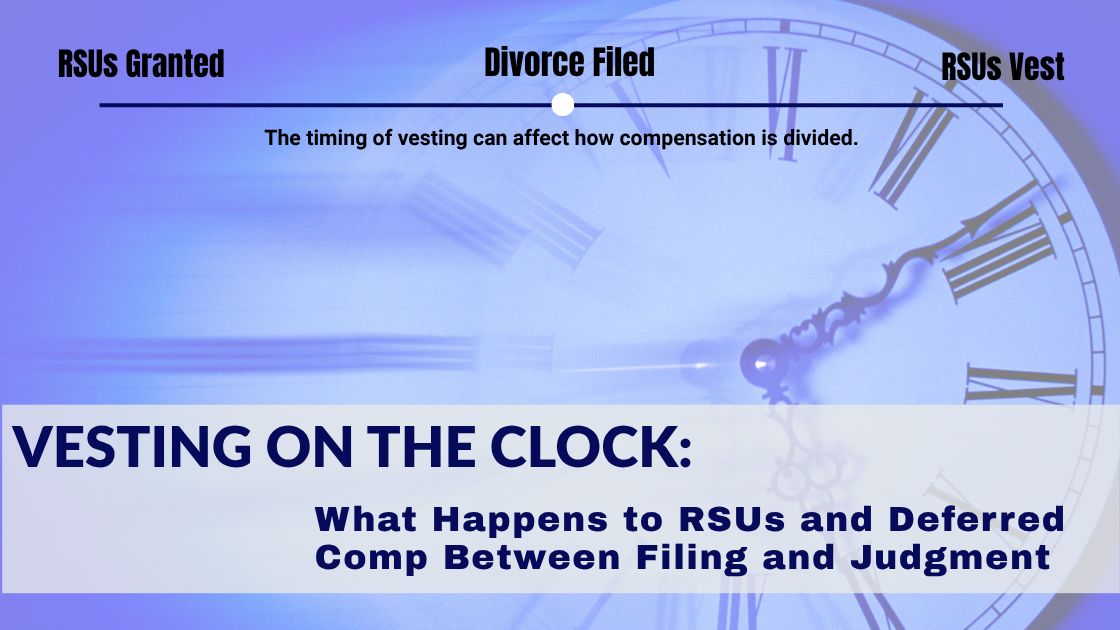
Most people understand that a divorce divides what you own on the day you file. What they miss is that in an executive’s divorce, the compensation does not stop the day you file. It keeps vesting. Tranches of restricted stock keep hitting your account every quarter while the lawyers argue, and a deferred comp balance keeps growing between the day the case starts and the day the judgment is signed. That gap can run a year or two or three. For someone with a large equity package, a great deal of money vests inside that window, and who it belongs to is one of the sharper fights in a high net worth case.
I have written before about the moment of filing and why the date of commencement matters so much in New York. This is the companion problem. Not what you had on the day you filed, but what keeps landing after.
The Date of Commencement Sets the Line, Not the End of the Story
In New York, the marital estate is generally measured to the date of commencement, the day the divorce action is filed. Assets acquired after that date are generally separate. So the first instinct is simple. RSUs that vest after I file are mine.
Sometimes. Not always. The problem is that a restricted stock unit granted during the marriage but vesting after you file does not fit neatly on either side of that line. It was awarded while you were married. It vests while you are divorcing or even after you are divorced. Part of it may be marital and part of it separate, even though the vesting date falls after commencement. The date of commencement tells you when the marital window closes for acquisition unless the equity granted is part of a bonus. As you can see, the date of commencement does not, by itself, tell you how to treat an award that straddles the line. You need an attorney strong in finances and who understands executive compensation fully to advocate for how to treat the award.
Why an RSU Straddles the Line
Restricted stock units are a promise of shares that convert to actual stock on a schedule, provided you stay employed. That structure is exactly what makes them hard to divide.
The key question is why the grant was made. An RSU awarded as a reward for work already performed looks backward. If that work happened during the marriage, the award has a strong marital character even if it vests later. An RSU awarded as an incentive to keep you at the company looks forward. It is tied to service you have not yet provided, which points toward separate property for the portion earned after the marriage ends. Most substantial grants are a blend. They reward past contributions and lock in future service at the same time.
New York courts sort this out through the framework in the Court of Appeals decision in DeJesus, which apportions an award between marital and separate based on when it was granted, when it vests, and what it was granted for. I have written separately about how DeJesus is used and misused, so I will not repeat the mechanics here. The point for this discussion is narrower. A grant made during the marriage that vests during or after the divorce almost never belongs entirely to the employee spouse, no matter how confident that spouse is on the day they file. But filing fast will protect more of the stock in accordance with the DeJesus formula.
What Actually Happens Between Filing and Judgment
Here is the practical picture. You file. Over the next eighteen months, several vesting dates arrive. Shares hit your account. Maybe a deferred compensation payout comes due. Meanwhile the case grinds on.
A few things have to happen for this to be handled correctly. First, you assemble the full grant history. Every award, its grant date, its vesting schedule, and the plan document behind it.
Guessing from a pay stub is not enough, because the pay stub does not tell you what each grant was for. Second, each tranche that vests during the case gets characterized, some marital, some separate, sometimes split within a single grant. Third, the tranches that vest while the case is pending need to be accounted for and, where appropriate, preserved, so they are not spent or moved before the court can address them. In New York, the automatic orders that take effect at the start of a divorce restrict transferring or dissipating assets while the case is pending, and vesting equity is not exempt from that.
This is also where a non-employee spouse gets hurt if they are not paying attention. Executive compensation is among the easiest categories of asset to overlook, because it does not usually show up cleanly on a tax return until it vests. A spouse who does not run the household finances may not even know the full grant schedule exists. If you are that spouse, the vesting that happens during the case is not a side issue. It can be one of the largest pieces of the marital estate, and it is arriving in real time while the divorce is pending.
The Tax Layer on Top
There is one more wrinkle that separates a clean division from a costly one. RSUs are generally taxed as ordinary income when they vest, at the recipient’s rate. So when a tranche that is partly marital vests in the employee spouse’s name, that spouse absorbs the tax, and the after tax value is what actually should be divided, not the gross number on the vesting statement. If a settlement divides the gross value and ignores the tax, the employee spouse pays twice, once to the government and once to their former spouse. A true-up provision that accounts for the tax at vesting is often the right tool. The mechanics of executive compensation are exactly the kind of detail that gets missed when equity is treated as a number on a statement rather than an asset with its own tax and timing behavior.
Supreme Court, Not Family Court
As with every financial issue in a New York divorce, this is decided in the Supreme Court, the court that hears divorce and divides the marital estate. Family Court does not divide property or apportion an equity package. If your case involves a meaningful book of restricted stock or deferred compensation, you are in Supreme Court, and you want an attorney who reads grant documents and vesting schedules, not one who treats the whole package as a single line item.
What This Means If You Hold Equity and Are About to File
If a significant part of your compensation is restricted stock or deferred comp, the filing date is the beginning of the analysis, not the end. Awards granted during the marriage will keep vesting after you file, and those tranches usually carry marital character that has to be apportioned, preserved, and divided on an after tax basis.
Do not assume that filing draws a clean line and everything after it is yours. And if you are the spouse who does not hold the equity, do not assume it is out of reach because it vests after the case starts. On both sides, the money that vests on the clock is very much in play, and getting it right takes grant level detail and an attorney who works at that level. If equity compensation is part of your marriage, make sure it is handled correctly before and during your case. If you have executive compensation and you are divorcing, make sure to retain an attorney familiar with these issues.
The information in this article is for general educational purposes only and does not constitute legal, tax, or accounting advice. Please consult a qualified New York divorce attorney and financial professional regarding your specific circumstances.